Six Months After He Broke His Neck, He's Running a Costume Contest
Six Months After He Broke His Neck, He's Running a Costume Contest
Somebody you know is going through something terrible right now, and you haven't called.
Not because you don't care. Because you opened the message four times, typed something, read it back, and deleted it. It sounded hollow. It sounded like you were making their catastrophe about your feelings. It sounded like a greeting card.
So you closed the app and told yourself you'd think of something better tomorrow.
That was a while ago now. And the longer it goes, the more a short message feels insufficient and a long one feels strange, and the whole thing hardens into something you avoid thinking about.
We know exactly how that works, because we did it this year.
Nick and Jac
In January we were at the year-end water ski awards banquet. Gatsby theme. Jana took Athlete of the Year, and I would like the record to show that I did not get a trophy.
Across the room were the best-dressed people in the building. A couple, mid-conversation with everybody, lighting the place up. Nick and Jac Lyman. Jac is not short for anything, and she will tell you so.
They make ski equipment. At the end of the night they were onstage drawing raffle tickets for a pair of their own ski skates, and I had bought a pile of tickets, and they called mine. So now we had a reason to talk. We left saying what you say when you meet people you want in your life: we should get together, you'll have to teach us how to use these.
They felt like a slightly younger version of us.
March
Then came a phone call.
Nick had been running a show ski maneuver when the wake caught his skis wrong. He went down and hurt his neck. The pain got worse over the following days until he went to the hospital, and on March 29th he had a laminectomy. The surgery went fine. The pain afterward was not fine.
A week later a scan found an epidural hematoma on his cervical spine, and he went back in for emergency surgery to drain the bleeding.
He came out of that unable to move anything below his neck. He could feel it when people touched him. On April 10th he moved the fingers on his right hand.
I'm using their own words here, from the updates Jac has been writing publicly, because those are the facts I'm sure of. Everything else I've heard secondhand and it isn't mine to publish.
We had nothing
Here is what Jana and I are: two people who have spent two decades in the middle of adaptive sport.
Jana broke her back at fifteen. She has been on three Paralympic teams. She is a world champion adaptive sit skier. I have spent our entire marriage as the able-bodied half of a household where disability is a daily operating condition.
And when that phone call came, we had no idea what to say.
We don't know what Nick's days are like. We don't know his level of function, his prognosis, his pain. We don't know how he showers or eats or sleeps or what any of it costs him. Jana's injury is not his injury and her body is not his body, and anything we might have offered from our experience risked landing as I know exactly how you feel, which is both untrue and one of the worst things a person can hear.
So for a while, we did the thing. We checked in on him from a distance. We watched the updates. We didn't reach out properly, because we were waiting to have something useful to say.
The man who couldn't scratch his own nose
Jana was fifteen, in a rehab hospital, and everything she had planned for herself was gone.
There was a man there, a quadriplegic, further along than she was. At some point she scratched his nose for him, because he couldn't.
And he told her she didn't know how lucky she was.
Not gently. Not as a lesson. Just as a fact from where he was sitting.
It did not fix anything. She didn't have a revelation in the hallway. But that night she got out a piece of paper and started writing down every single thing she could still do.
That list is the hinge of her entire life. Everything after it, the teams, the medals, the championship, runs downstream of a girl in a hospital deciding to write an inventory of what was left instead of what was taken.
Look at the man who caused it.
He had no expertise in her situation. He had a different injury, a different body, a different life. He had no plan for her, no advice, no program. He wasn't a therapist or a coach or a mentor.
He was just there, and he was willing to say a true thing to a teenager who was in the room with him.
That's the whole mechanism.
Willingness beats expertise
You do not need to understand somebody's catastrophe to be useful inside it.
You are not going to solve it. You are not qualified. Neither is anybody else, including the professionals, who can only solve parts. The fantasy that you need the right words before you're allowed to show up is the thing keeping you out of the room, and the room is the only place you can actually do anything.
What you need is willingness. The willingness to be awkward, to say the wrong thing, to be told the wrong thing was wrong, and to still be there next week.
If you want the words, here they are, and they are not clever on purpose:
"We love you. We're here. We don't understand everything you're going through, but we want to."
That last clause is the one doing the work. Not we understand. We want to. One is a claim you can't back and the other is an offer you can keep.
Living Lucky® Practice
The Message You Haven't Sent
Somebody came to mind while you were reading. This is for them.
Do not try to write it well. Written badly and sent beats written beautifully and deleted.
01 Who is it?
The name that arrived first. Not the one you decided was more appropriate a second later.
02 What has been stopping me?
Be specific. Not knowing what to say. Fear of intruding. Guilt about how long it has been. Write the real one.
03 The message.
Start here if you are stuck: I love you. I'm here. I don't understand everything you're going through, but I want to. Put it in your own words. Three sentences is plenty.
04 One concrete offer.
Not "let me know if you need anything," which puts the work on them. Name a specific thing on a specific day, and make it easy to decline.
05 Who else is in that house?
A spouse, a parent, a sibling, a grown child. Somebody's whole life changed on the same day and nobody is asking how they are. Write their name, and message them separately.
06 When am I sending it?
Write a time today. Then set a reminder for four weeks out, because the hard part is not the first message. It is the fifth one, after everyone else has gone quiet.
Two ways people get it wrong
Pity. Focusing entirely on what's been lost. It feels like compassion and it lands like a verdict. Everyone in a hard season can tell the difference between someone who is with them and someone who is relieved not to be them.
Forced optimism. Demanding that somebody find the silver lining on your schedule. Everything happens for a reason, you're so strong, you'll come back better. That isn't hope, it's a request that they manage your discomfort by performing recovery.
The thing that works sits between those, and it's a question rather than a statement.
If this could work, what would it look like?
That sentence is the most useful tool I own.
It doesn't argue with reality. It doesn't demand that anyone feel better. It opens a door and leaves it open, and the other person gets to decide whether to walk through.
A few versions:
If this could work, what would it look like?
If we did it with only what we have right now, how would you want it done?
What kind of support would actually be helpful to you today?
That third one matters more than people realize. Most help gets delivered according to what the helper felt like providing. Asking first hands the person back a piece of their own authority on a day when a great deal of it has been removed from them.
I have doubted out loud exactly once
I should admit I'm not naturally good at this.
When Jana came out of the water and told me she wanted to be world champion, my first thought was that's too big a goal.
I didn't say it. I caught it, which is the only thing I did right in that moment, and I asked the question instead. If it were possible, what would it look like? What training, what community, what support, what would we have to do every single day?
We put it on paper. Then we did it. Fourteen months later she came out of the water a world champion and I was crying on the shore.
The reflex to call something impossible arrives before you've examined anything. It is fast, it feels like realism, and it is almost always just unfamiliarity wearing a costume. You don't have to defeat it. You only have to notice it, and then ask the better question before it finishes speaking.
Somebody should check on the spouse
Jac's life changed on the same day Nick's did, and almost nobody is calling her.
That's how it goes. Attention flows to the injured person, which is right, and the partner becomes logistics. She learns the equipment and the medications and the insurance appeals. She relocates. She manages the updates to a community that needs reassuring. She grieves a shared future that nobody is holding a vigil for, mostly while driving.
If you only have the energy to reach out to one person in a household like that, consider reaching out to the one everybody else is forgetting.
I know a little about this from the inside. I didn't know the first thing about disability when I met Jana. When my sister told me she wanted to introduce me to an extraordinary woman, I said, great, I could use a friend, it's not like I'm going to marry her.
Living with Jana for two decades has been a doctoral program in adaptability that I did not enroll in and could not have designed. Everybody adapts constantly. A disability just means you get the advanced course, on a compressed schedule, whether or not you were ready.
What Saturday looks like
Here is where the story stops being about helping somebody.
Nick spent six months at Shepherd Center in Atlanta rebuilding his body, his mind and his spirit. Jana's own coach, Bill Furbish, came out of Shepherd. Jana skied on the Shepherd ski team before and during her years on the national adaptive team. That place is woven through our life, and now it's woven through theirs.
This Saturday, October 17th, at the Show Ski School at Jack Travers in Groveland, Florida, Nick and Jac are putting on the Groveland Homecoming. Men's and women's freestyle. Men's finals. Trios. And adaptive skiers taking the water between every single competition round, because, as they put it, it reminds everyone how much life and sport are still ahead.
It is a fundraiser. Not for them. For Shepherd's Catastrophic Care Therapy Program, so the place that caught them can catch the next family.
And the costume contest rules, posted by a man six months out from a spinal cord injury, read as follows. Theme is vintage show ski. Make sure you can ski in it. One men's winner and one women's winner.
Athletes without flair will be publicly mocked.

The event flyer
I have read that line about nine times.
We spent months trying to work out what to say. The answer, it turns out, is that on Saturday we show up at a lake in Groveland wearing something ridiculous, and Jana takes the water between the rounds for Nick and Jac and for Shepherd, and we lose the costume contest to somebody in their uncle's 1970s doubles outfit.
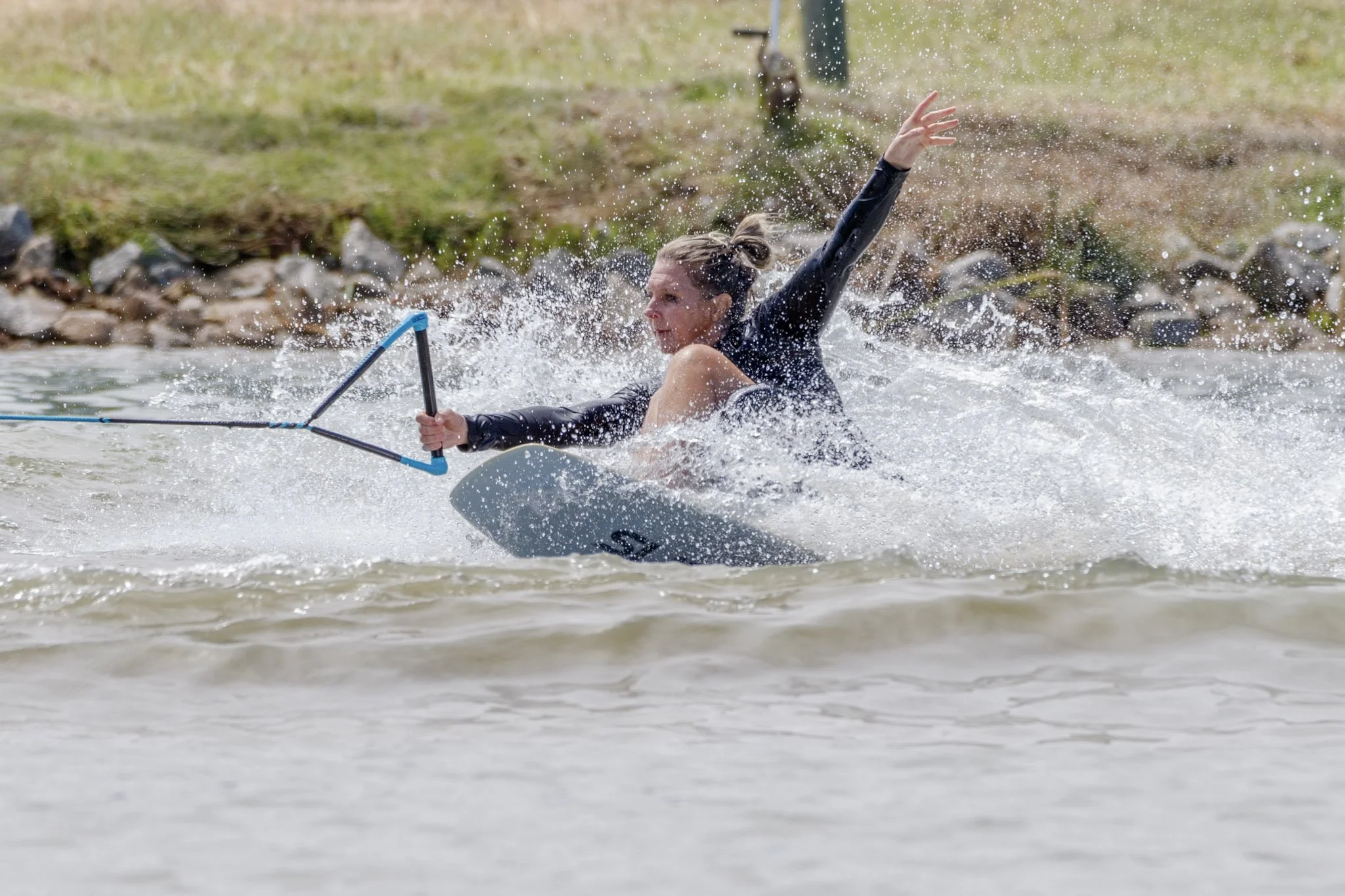
That's it. That's the whole thing. You don't have to be the expert. You don't have to be the teacher. You don't even have to understand.
You just have to be willing.
If you want to do something
Donate to Shepherd's Catastrophic Care Therapy Program, which is what Nick and Jac have asked people to do: donate.shepherd.org
Register or come watch the Groveland Homecoming on October 17th: flymanskis.com
The family's fund is still open for the medical and living costs: Support Nick Lyman's Recovery
If you're reading this long after Saturday, the first two will have moved on and the need won't have. Spinal cord injury is a decade-long expense and the casseroles stop in week three.
Where this sits in the formula
What do I want to experience? Being the kind of person who shows up before he knows what to say.
How do I want to grow? Past the belief that I need credentials to be useful to someone I love.
How do I want to contribute? Presence first. Questions second. Advice only if asked, and usually not even then.
How lucky am I? That a stranger told a fifteen-year-old girl she didn't know how lucky she was, and she believed him enough to pick up a pen.
The Living Lucky® Practice
Exercise: Name the person you've gone quiet on. Send them a message today. It does not have to be good.
Reflection question: Who have I failed to contact because I was waiting to have something useful to say?
Journal prompt: Where am I calling something impossible before I've asked what it would look like if it worked?
Action: Ask one person in a hard season this exact question: what kind of support would actually be helpful to you right now? Then provide that, rather than the thing you had in mind.
Frequently asked questions
What do you say to someone whose life has just been turned upside down?
Something true and short. "We love you, we're here, we don't understand everything, but we want to." Offering to understand is a promise you can keep; claiming to understand is one you can't.
What if I say the wrong thing?
You will. People in crisis are far more forgiving of clumsy presence than of total silence. The wrong words from someone who showed up are repairable. Absence is the thing that gets remembered.
How do I help without giving unwanted advice?
Ask instead of tell. "If this could work, what would it look like?" and "What kind of support would be helpful today?" leave the other person in charge of their own life, which matters enormously when so much else has been decided for them.
Is it too late to reach out if months have passed?
No, and later is often better. Attention floods in during the first weeks and disappears by month three, right when the long part begins. A message in month six frequently means more than one in week one.
What about the spouse or caregiver?
Contact them directly and separately. Their life changed on the same day and almost nobody is checking on them, because they've been reclassified from person to logistics. Ask how they are, not how the patient is.
Do I need experience with their situation to be useful?
No. The man who changed the course of Jana's life was a stranger in a hospital with a different injury and no plan. He was present and he was honest. That was enough, and it is almost always enough.
Somebody is waiting to hear from you and has stopped expecting to.
Send it badly. Send it today.
We Create Our Luck®.
Hear the full conversation on the Living Lucky® Podcast with Jana and Jason Shelfer, Season 11, Episode 46: "You Don't Need Answers to Help: Why Willingness Beats Expertise." Listen to the audio, watch the video broadcast, and tell us what truly being there for someone means to you.