Somebody's Having a Party and I Wasn't Invited
Somebody's Having a Party and I Wasn't Invited
Our neighbor Tim said that to me a few days after, out in the street. He was by himself, knocking a ball around with a hockey stick, which is how he stays moving now, and we fell into one of the thirty-minute conversations we end up in every few weeks.
He was joking. Tim listens to this show. He and his wife support what we do. He knows perfectly well he could walk into any party at our house without being asked, and he'd be welcome.
He said it anyway, because saying it was how he opened the door.
Tim isn't lonely and he isn't a stranger. He's a friend who wanted in and had no way to say so except as a joke, in the street, with a hockey stick in his hand.
Adults do not invite themselves. Not even the ones who know they'd be welcome. Everybody is standing around waiting to be asked, including the people you assume don't need asking.
Then he brought up the oysters. Eight or nine years ago we threw a party on this street that he still mentions, unprompted, most of a decade later. I'll come back to it.
The thing almost everyone is doing right now
You want to stay home. You want to shut the door, protect your peace, not be looked at by anybody for a few hours.
You also want someone to really know you.
Both of those are running at the same time in most adults I talk to, and they cancel each other out. You stay in, which was the right call for your nervous system and the wrong one for your life, and then you do it again next weekend, and the weekend after that.
Meanwhile the thing you'd need in order to fix it is getting weaker.
Jana calls it a muscle, and she's right. There's a skill involved in standing in a room with people you don't know well and letting the conversation go where it wants. Not managing it. Not performing. Just being in it. And like anything else you stop using, it atrophies.
We're the most connected generation in history and we have never been worse at this. Text threads and likes and check-ins are touchpoints, not proximity. They keep you informed about people without putting you in a room with them, and the room is where everything actually happens.
So we tried something.
The Living Lucky® Salon
We set a date three months out and sent invitations. The date was October 10th, 2026.
Jana didn't think twice about it when we picked it. Then she started noticing 10/10 come up in the work of Jose Silva, whose material she's studied for years, as a date that carries a sense of fresh beginnings. Make of that what you want. We liked it. It felt like a wink.
The idea was simple and we had no idea whether it would work: invite interesting, eccentric, open-hearted people into our home and have conversations worth having.
One rule. No small talk.
Toast of the Season
The whole mechanism is three questions, and it costs nothing.
Everybody answers one of three questions:
What have you just accomplished that you're excited about?
What are you working on right now?
What are you dreaming about starting next?
That's it. That's the invention. We called it the Toast of the Season.
What it does is replace the default opener, which is so what do you do, and which has never once in human history led anywhere good. What do you do asks a person to summarize themselves into a job title and then stand there while you decide how impressed to be.
These three questions do the opposite. They put something live on the table. A win nobody's celebrated. A project mid-build. A dream somebody hasn't said out loud yet.
And the second a person says one of those things in a room, everybody else in the room has something to do with it. Celebrate it. Add to it. Say I know somebody. Say I did that, here's what I'd watch out for.
You cannot help someone with a job title. You can help them with a dream.
We were nowhere near ready
Jana ordered food for thirty people. The morning of, we got a wave of cancellations. She was stressed about the food, stressed about the number, stressed about whether a room full of people who mostly didn't know each other would just stand there.
The staffing agency called me and asked whether I was sure I needed two people. I said yes. I didn't think we'd need two. I wanted two, because my wife was stressed and I wanted the night to be seamless for her.
At 5:05 the house was empty and we looked at each other.
Then the gate started chiming and it didn't stop. A couple dozen people came through that door.
We jumped off the cliff and sewed the parachute on the way down, which is how we do most things. Waiting until you're ready is the single most effective way to never do it. There is no version of this where you feel prepared. The house is never finished. The guest list is never right. You either send the invitation or you don't.
Living Lucky® Practice
Host Your Own Salon
Everything on this page is free. Fill it in now, while you still feel unready, because that feeling does not go away on its own.
A crockpot and a kitchen table runs this just as well as catering does.
01 The date.
Six to ten weeks out. Write it down before you decide anything else. The date is what makes the rest real.
02 The bookends.
A start time and an end time, both on the invitation. Three hours is plenty.
03 The list.
Interesting beats convenient. Invite more than you want, because people cancel and that is fine. Mix circles that have never met.
04 The prompt.
Use the Toast of the Season, or write your own. One question, asked of everyone, answered out loud in a circle.
What have you just accomplished? · What are you working on? · What are you dreaming about starting?
05 What keeps me out of the room.
Name the jobs that would trap you in the kitchen all night. Then decide what gets bought, delegated, simplified, or skipped.
06 What I am waiting to be ready for.
Write it down, look at it, and send the invitation anyway. It will still be unfinished on the night and nobody will notice.
The light flicker
At some point in the evening I started flicking the lights on and off to get everybody's attention.
Jana's reaction, in her own home, was immediate alarm. We're in Florida, there were hurricanes moving through, and she thought we were losing power.
Then she remembered something else. Her dad used to flicker the porch lights when she was out there kissing boys.
I had follow-up questions about that. We'll get to those another time.
Anyway, the lights worked. Everybody circled up, and we went around the room, and each person said their piece. A win, a project, a dream. Short. Nothing rehearsed.
Watching that was the best part of the night for me.
Most of us do the whole thing in silence. We accomplish something and move straight to the next item without ever saying it out loud to anybody. We forget what we've made it through. We forget we're any good. Standing in a circle saying one true thing about your own life, to people who have no reason to compete with you over it, does something that no amount of private journaling will do.
Jeniece
We hired two people to help in the kitchen so Jana could actually be at her own party instead of running it.
When Jeniece arrived I asked her for something unusual. I told her to take ownership of the night. Pretend this is your home. These are your guests, even though you're meeting every one of them for the first time, and you won't get to know any of them deeply tonight. Your job is to make sure they're so well taken care of that they can forget about everything except each other, and they walk out associating this room with a great time.
She did exactly that. She filled every gap before anybody noticed there was one.
At the end of the night she came up to Jana and said it was the best event she'd ever been to. That she needed to be there. That the conversations she'd overheard had changed her life.
I watched Jana's face when that happened and I'm going to remember it for a while.
I didn't give Jeniece a task list. I gave her a role. People who are handed a job stand at the edge of a room. People who are handed ownership stand in it. She wasn't staff overhearing a party. She was inside it, because of a sentence at the door.
If you hire help for something like this, that's the sentence. It costs nothing and it changes who they get to be for three hours.
Bookends
Five to eight. We said it on the invitation and we meant it.
Jana's fifty-one and I'm a couple of years ahead of her. We have both hosted the other kind of party, the one that drifts into the hot tub at one in the morning and ends with you coming downstairs the next day to find twenty people still in your house.
Those were good parties. I'm not sorry. But I can't do one of those and then be any use to anybody for two days, and if the recovery costs that much, you stop hosting entirely. Most adults quit gathering for exactly this reason. Not because they stopped liking people. Because the whole thing became an ordeal with a hangover attached.
A start time and an end time fixes it. Guests know what they're committing to. You know when you get your house back. People still linger a little, and that's fine, because lingering past eight is different from a night with no shape at all.
The bookends are what make it repeatable. And repeatable is the entire point, because one great party doesn't build anything. Four a year does.
The oyster version
So, the oysters. The thing Tim brought up in the street.
We called it the Shelfer Shucker. Eight bushels of raw oysters, a keg or two of beer, a musician playing out by the pool, and two shuckers the oyster supplier sent along to keep the line moving. Open to the whole neighborhood, while supplies lasted.
One of the neighbors posted on the neighborhood thread: Did you just invite 500 people to your house?
That lit the thread up for a day. We did it again the next year.
People on this street are still friends because of those two nights. Not friendly. Friends. And a neighbor was still raising it with me, out of nowhere, all these years later, which tells you how rare the experience must be if one evening of oysters is still earning interest that long.
We stopped after two.
Not because they didn't work. And it wasn't the oysters. The supplier sent the shuckers, and that end of it was manageable.
It was the entertaining. Everything that surrounds hosting a whole neighborhood at once, which came to four or five thousand dollars a time. We were in a generous season, and four here and five there adds up faster than anybody plans for. It got hard to sustain and we let it quietly drop.
The thing a party is named after is almost never the thing that costs you.
Which is why the salon looks the way it does now. A smaller room, a start time and an end time, a question instead of eight bushels of oysters. That isn't a downgrade. It's the version that still exists in ten years.
The Shucker didn't fail. It worked, and then it priced itself out, and the friendships it started never got a third night to grow on. That's the part I'd do differently.
I would have told you the Shucker had no prompt. People came and went all afternoon until the oysters ran out, and that was the whole plan.
Then I went back through the photos.
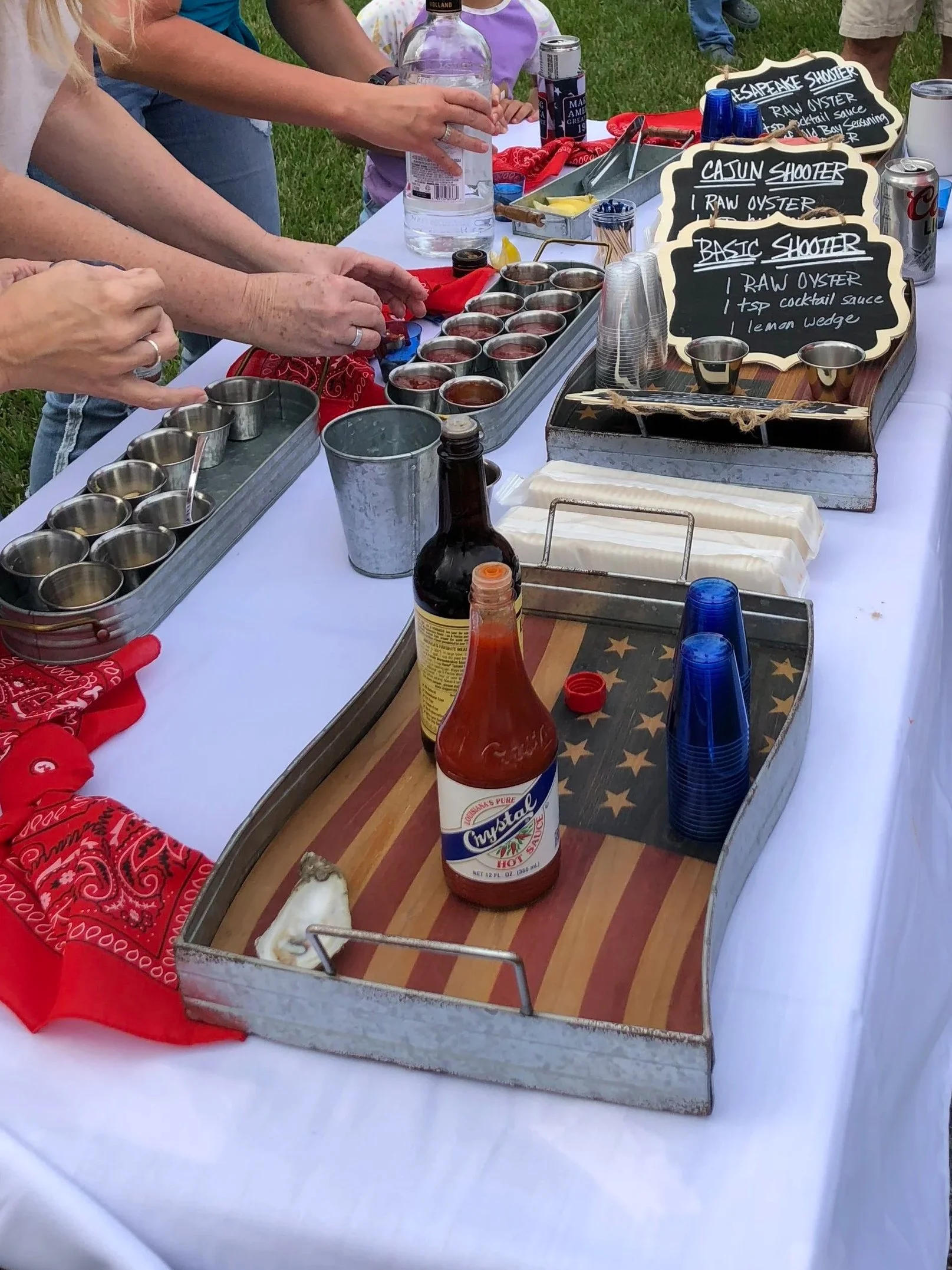
There's a row of little chalkboards along the table. Basic Shooter. Cajun Shooter. Chesapeake Shooter. Russian Shooter, which was a raw oyster, cocktail sauce, a lemon wedge and a teaspoon of vodka. One of the neighbors photographed the board and posted it with the caption pick your poison.
That's a prompt. It isn't a question, and it does the identical job. It hands people something to do with each other. Strangers compare. They dare each other into the Russian. They come back to report. Nobody standing in front of that board has to invent a conversation, because the board handed them one.
So the two parties are less different than I thought. The salon used three questions and a circle. The Shucker used a chalkboard, a table that puts you shoulder to shoulder with whoever is next in line, and a guy with a guitar.
Every gathering that works has something in the middle of it that isn't the people. A question, a menu, a game, a fire. Put something there, then get out of the way.
And somebody still has to open the door.
What it actually cost
We did the comfortable version of this, and you might read that and decide it isn't available to you.
There was a catered charcuterie board that took up most of the kitchen island. Lemon drop martinis with a recipe I'm not giving up, which contains limoncello and simple syrup and sneaks up on people. Four bottles of Veuve for the toasts across a couple dozen guests, which works out to about a glass and a half each, so nobody was doing anything regrettable.
None of that made the night work.
The three questions were free. The circle was free. The start time and the end time were free. Telling Jeniece to take ownership instead of handing her a task was free. Sending the invitation before we felt ready was free, and it was the hardest thing on the list.
Catering and champagne buy comfort. Comfort is pleasant and it is not connection. Don't let our kitchen island talk you out of your kitchen table.
Years ago Jana and I picked a word, and the word was extraordinary. We aim at it on purpose, and when we build something we engineer it.
We also overshoot constantly and we know it. We work on it with our coach every week, and we talk through every event we plan before and during, specifically to stay tethered. Without that, one of us orders a unicorn. There would be a Pegasus in the driveway with a photo line, and the other one of us would have justified the expense in under a minute.
So take the catering and the champagne for what they are. Two people with a known condition, managing it imperfectly, in public.
Then look at what the last two months actually held.
A few weeks ago we went to a game night at somebody else's house. No staff, no theme, nothing engineered. It was every bit as good as our salon for real connection and we are openly campaigning to be invited back.
One evening we walked three houses down to a neighbor's fire pit. They already had a fire going. We brought our own cups. We sat under the oaks by the lake and talked for hours, and it cost nobody a dollar.
Nothing we engineered produced anything those two nights didn't.
Which is the actual reason we build the engineered version at all, and it isn't so people keep coming back to our house.
The aim is that somebody gets one night where the experience of other people, of themselves, and of life in general is unmistakably good. Vivid enough that they'd know the feeling if they ran into it again. Because then they start finding it on their own, out in the wild, where we aren't.
We built a salon in October and then walked three houses down and found the whole thing at a fire somebody else had already lit. That's the method working on the two people who made it.

Sunset in the back yard over the lake in Winter Garden.
Where this sits in the formula
What do I want to experience? For us this year the answer was two words we'd each picked back in January. Jana's was relationship. Mine was connection. The salon wasn't a random idea. It was ten months of pointing at the same thing and then finally building the room.
How do I want to grow? Into somebody who hosts instead of somebody who waits to be invited. Those are different people and one of them has a much better year.
How do I want to contribute? Make a space. Hand people a question. Get out of the way.
How lucky am I? That a couple dozen people cleared a Saturday evening to come to our house. That one of them was moved enough to say so. That Tim wants in next time.
Luck doesn't arrive. It gets built, usually in rooms, usually by somebody who sent an invitation before they were ready.
The Living Lucky® Practice
Exercise: Write down six people you'd like to know better. Not your closest friends. The ones you always mean to see.
Reflection question: When was the last time I was in a room where I didn't have a role to play?
Journal prompt: What's the thing I keep meaning to host, and what am I waiting to be ready for?
Action: Pick a date eight weeks out. Send the invitation this week, before the plan exists.
Frequently asked questions
Why is it so hard to make friends as an adult?
Most adult interaction is digital, which produces frequent contact without proximity. Without regular in-person practice, the ability to hold unstructured conversation weakens. Add the normal fear of being judged and most people keep the mask on, which prevents the trust that friendship requires.
What is the Toast of the Season?
A three-part prompt that replaces small talk at a gathering. Each guest shares a recent win, something they're currently working on, or a dream they want to start. It gives the room enough context to celebrate, offer resources, or help, which a job title never does.
How do you host without exhausting yourself?
Set a clear start and end time, and remove the friction that keeps you out of the room. The goal is to be a guest at your own party. A host trapped in the kitchen for six hours has run an event, not a gathering, and won't want to do it again.
Do you need money to host a gathering like this?
No. The parts that generate connection are the prompt, the circle, and the time boundary, and all three are free. Catering and good champagne buy comfort, not conversation.
What if people cancel?
They will. We ordered for thirty and lost a chunk the morning of, and the night was still the best one we've had in years. The number in the room matters far less than whether the room has a question to answer.
How often should you do this?
Often enough to be repeatable. We're aiming for quarterly and we'll settle for twice a year. A single great party is a memory. A recurring one is a community.
We're doing it again. Tim is getting an invitation he never needed and clearly wanted.
If the idea of hosting something makes your chest tight, that's not a sign you shouldn't. That's the muscle telling you how long it's been.
Pick a date. Send it before the plan exists.
And if hosting is more than you have in you right now, that's fine. Walk down the street to somebody's fire and bring your own cup. That counts. That might be the whole thing.
We Create Our Luck®.
Hear the full conversation on the Living Lucky® Podcast with Jason and Jana Shelfer, Season 11, Episode 45: "1000 Friends, No One To Call." Listen to the audio, watch the video broadcast, and tell us your Toast of the Season.