

BLOG POSTS


What Do You Do When You Miss a Day? Or a Month?
I want to say something else that I think is important and that most people in the personal development space won’t say out loud.
The drift is not a sign that the practice isn’t working. It is often a sign that it is.
Here’s what I mean. When the practice is working, you are growing. You are examining stories, shifting beliefs, making decisions you’ve been postponing, having conversations you’ve been avoiding. That is not comfortable. Growth rarely is. And sometimes, somewhere in the middle of real growth, the part of you that preferred the old stability quietly engineers a reason to stop doing the thing that’s changing you.
4 Minutes a Day. What’s the Cost of Skipping It?
The unexamined pattern becomes the life you’re living on autopilot while the life you actually want keeps getting pushed to someday.
I’ve sat across from people in their fifties who are still carrying a story someone handed them when they were twelve. Not because they’re not intelligent or self-aware — they are both. But because nobody ever gave them a daily practice for looking at it. For putting it on a page and asking:
Is this still true?
Is this still serving me?
Is there a more empowered version of this story that is also true?
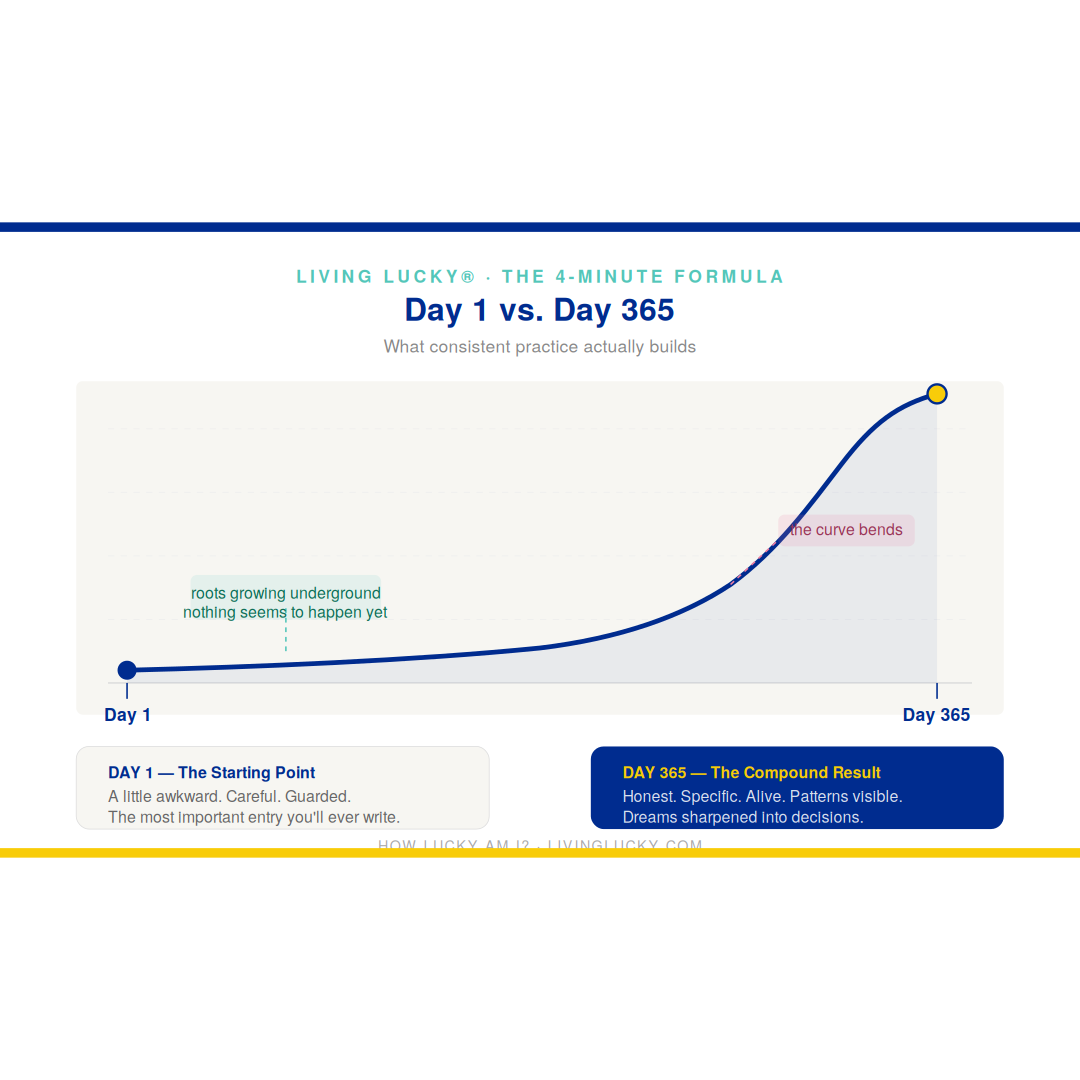
Day One Versus Day 365: What a Year of This Actually Looks Like
Here’s the thing about compound interest that most people understand in theory but underestimate in practice: the growth isn’t linear.
The first weeks of any practice feel almost imperceptibly small. You write your four questions, you go about your day, and it’s hard to point to something specific that changed. This is where most people quietly stop. Not with a dramatic decision to quit — just a morning where they skip it, and then another, and then the journal ends up in the drawer.
What they didn’t know is