BLOG POSTS


The Skeptic’s Guide to WhyJournaling Actually Works
The research on journaling is not soft. It is not the product of wellness culture or self-help optimism. It comes from peer-reviewed studies published in serious academic journals, replicated across populations, measuring outcomes that skeptics care about: immune function, cortisol levels, doctor visits, cognitive performance, emotional regulation, goal achievement, and recovery from adversity.
Let’s go through the strongest findings.

What Do You Do When You Miss a Day? Or a Month?
I want to say something else that I think is important and that most people in the personal development space won’t say out loud.
The drift is not a sign that the practice isn’t working. It is often a sign that it is.
Here’s what I mean. When the practice is working, you are growing. You are examining stories, shifting beliefs, making decisions you’ve been postponing, having conversations you’ve been avoiding. That is not comfortable. Growth rarely is. And sometimes, somewhere in the middle of real growth, the part of you that preferred the old stability quietly engineers a reason to stop doing the thing that’s changing you.

Not a Journaler? Good. This One’s for You.
What I am going to do is offer you five ways to do this practice that have nothing to do with sitting down with a notebook and a pen and staring at a blank page. Because here’s what I know after two decades of coaching: the principle matters more than the medium.
The four questions workregardless of how you answer them. And if the way most people answer them doesn’t work for you, that’s not a problem with you. That’s just information about how you’re wired.
Let’s find your version.
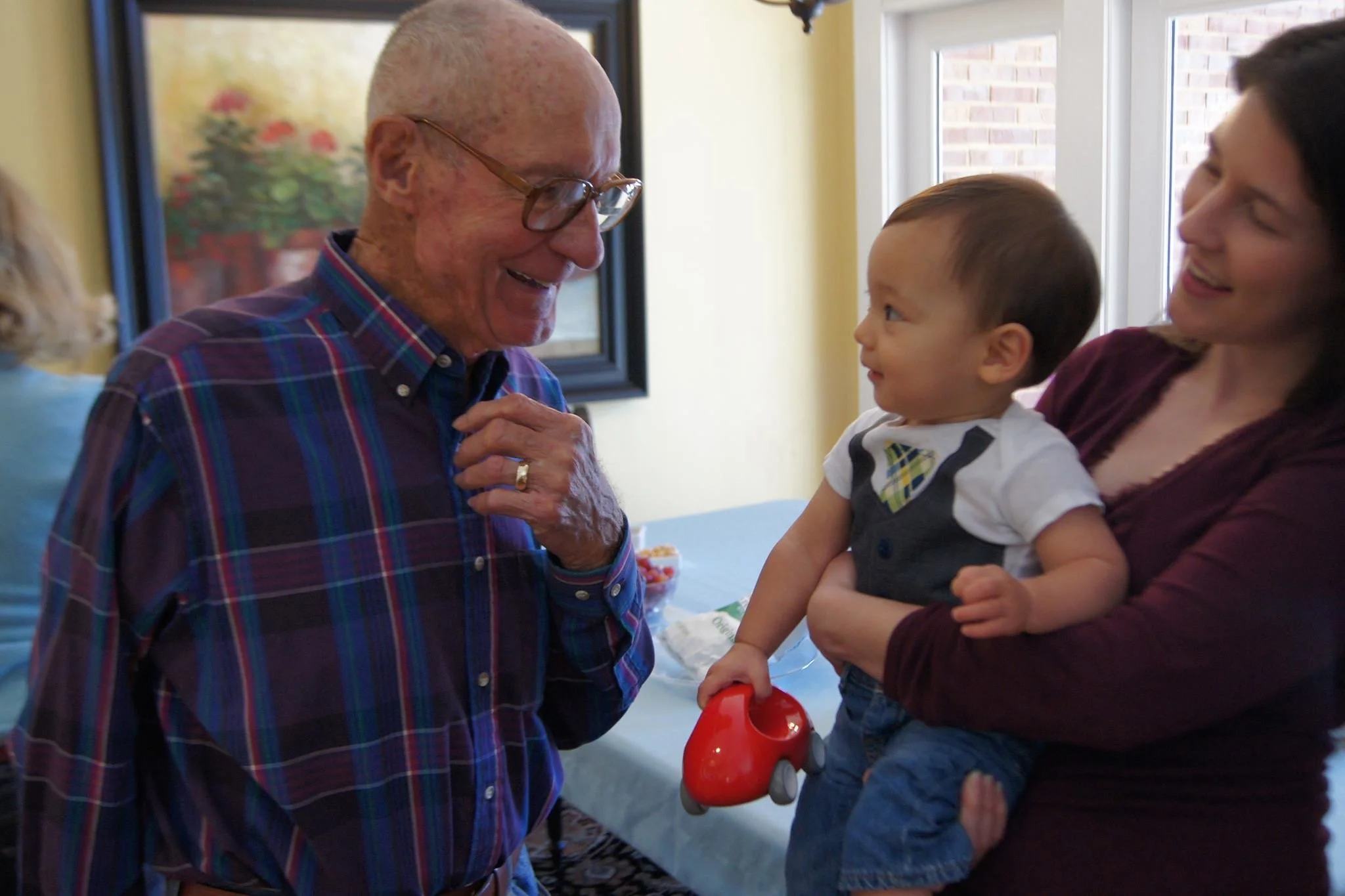
Jason’s Grandfather (Papa) Said the Same Word Every Single Morning. It Stuck.
His name was Rooster.
I don’t know the exact origin of the nickname. I just know that’s what everyone called him, that it suited him completely, and that no one who ever met him forgot him. My grandfather was the kind of person who changed the temperature of a room just by walking into it. Not because he was loud or demanding, though he could certainly hold a room. But because of the energy he brought.
Every single time. As if he’d decided somewhere along the way that walking through a door was an opportunity worth taking seriously.
Every morning, without fail, Rooster woke up and said the same thing.
“Boy, do I have Enthusimatism!”
Not enthusiasm. Not optimism. Enthusimatism.
How to Ask Yourself a QuestionYour Brain Actually Wants toAnswer
Your brain cannot hold an open question and not try to answer it.
That is not a motivational statement. That is a description of how your neurology works. The moment a genuine question enters your conscious mind, your brain begins searching for a response. It cannot help it. It is built to seek completion. Psychologists call this the Zeigarnik effect — the brain’s tendency to fixate on unfinished things until they are resolved. An open question is, by definition, unfinished. So your brain works on it. While you’re driving. While you’re in the shower. While you’re trying to fall asleep.
This is either the most useful thing about your brain or the most exhausting, depending entirely on what question you left open.

Four Questions. Four Minutes.Here’s Exactly How It Works.
In the eleven blogs before this one, we’ve covered the science, the stories, the cost of not doing this, and the philosophy behind why it works. If you’ve been reading along, you already understand more about how your brain operates than most people ever will. You understand the RAS. You understand the compounding effect. You understand what unexamined days cost and what intentional ones build.
So here it is. The whole formula. Right up front. No more buildup.
4 Minutes a Day. What’s the Cost of Skipping It?
The unexamined pattern becomes the life you’re living on autopilot while the life you actually want keeps getting pushed to someday.
I’ve sat across from people in their fifties who are still carrying a story someone handed them when they were twelve. Not because they’re not intelligent or self-aware — they are both. But because nobody ever gave them a daily practice for looking at it. For putting it on a page and asking:
Is this still true?
Is this still serving me?
Is there a more empowered version of this story that is also true?
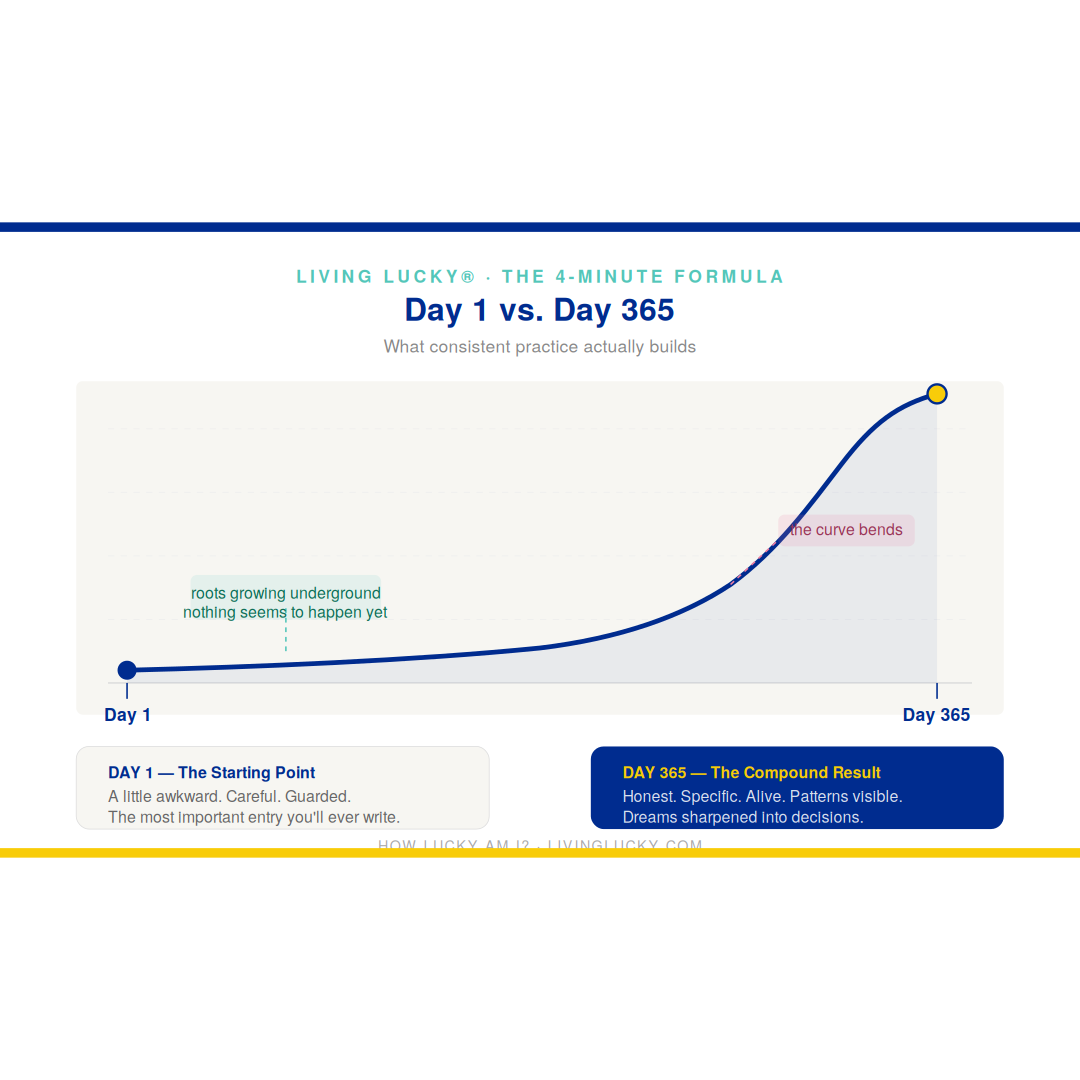
Day One Versus Day 365: What a Year of This Actually Looks Like
Here’s the thing about compound interest that most people understand in theory but underestimate in practice: the growth isn’t linear.
The first weeks of any practice feel almost imperceptibly small. You write your four questions, you go about your day, and it’s hard to point to something specific that changed. This is where most people quietly stop. Not with a dramatic decision to quit — just a morning where they skip it, and then another, and then the journal ends up in the drawer.
What they didn’t know is

The Questions That Work BetterThan “Why Did This Go Wrong”
There is a version of self-reflection that makes things worse.
Most of us know it well. Something doesn’t go the way we wanted — a conversation, a decision, a day, a season — and we sit with it and ask the question that feels the most natural: why did this go wrong? What did I do wrong? Why does this keep happening to me?
And then we answer it. In detail. With evidence. Our brain, which is very good at its job, builds a thorough and well-supported case. We replay the moment. We find the flaws. We catalogue the ways we fell short. We connect it to other times we fell short, because the brain loves a pattern and a pattern of failure is one it can construct quickly.
This is called rumination. And research is very clear on what it does: it keeps you stuck. Not in a motivating, productive, learn-from-your-mistakes way. In a circular, draining, nothing-changes way. Rumination feels like reflection. It is not. Reflection moves you forward. Rumination loops you back.
The difference between the two is not the topic. It’s the question.

What If You Could Be Grateful for the Hard Stuff Too?
There is a concept in psychology called post-traumatic growth — the idea that people who experience significant hardship often report not just recovering, but growing beyond where they were before. More resilient. More empathetic. Clearer about what matters. More willing to take risks because they’ve already survived the thing they were most afraid of.
The research on this is substantial and it keeps pointing to the same thing: the people who experience the most growth after adversity are not the ones who suffered the least. They’re the ones who found meaning in what they went through. Who asked not just “why did this happen to me” but “what did this make possible?”
You’re Not Stuck. You’re Just Telling Yourself aStory That Says You Are.
“You’re not stuck. You’re telling yourself a story that says you are. And the story feels so true that you’ve stopped looking for the exit.”
That usually lands somewhere uncomfortable. Which means it’s usually right.
Every belief you hold about yourself and your life started as a sentence. Someone said it out loud — a parent, a teacher, a coach, a friend, an enemy — or you said it to yourself in a moment of pain or disappointment or fear. And somewhere along the way, you stopped questioning it and started living it.

The Thing About Patterns Is — You Can’t See Them While You’re in Them
Ever feel like you keep ending up in the same situation, different year? Same job frustration, same relationship dynamic, same stuck feeling? There's a reason for that. And there's a way out of it.

Gratitude Isn’t a Buzzword. Here’s What It ActuallyDoes to Your Brain.
We know, we know. You've heard "just be grateful." But what if gratitude wasn't a feeling you waited for — what if it was a switch you could flip? Turns out, there's a lot of research on exactly that.

Why Writing by Hand Does Something Typing Never Will
You could type your thoughts. You could voice-memo them. But when your hand moves across a page and forms a word, something different happens in your brain. Science has a name for it. We just call it feeling it.
What Happens to Your Body When You Don’t Deal With Your Thoughts
Most people think stress is just a feeling. It's not. It's a chemistry experiment happening inside you right now. And the thoughts you haven't looked at yet? They're running the experiment.
The Body Keeps the Score. You don’t have to believe me. Ask Dr. Bessel van der Kolk, M.D.

Your Brain Is Listening To Every Question You Ask It
There's a part of your brain — about the size of your little finger — that decides what you notice, what you miss, and what you attract. And you've been programming it your whole life. The question is: what have you been telling it to look for?